Mix. Drink. Enjoy.
Discover amazing cocktail recipes and elevate your mixology game
Mix. Drink. Enjoy.
Discover amazing cocktail recipes and elevate your mixology game
Posted: July 14, 2026
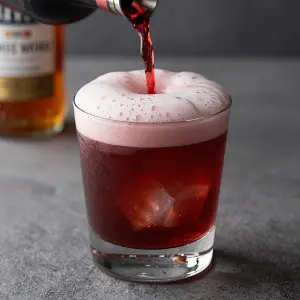
The New York Sour is a Whiskey Sour dressed up for a night out: bourbon, fresh lemon juice, and simple syrup topped with a dramatic float of dry red wine that turns the drink's surface a deep crimson and layers in fruit and tannin with every sip. Egg white gives it a silky foam that carries the wine's color beautifully, and it shares its wine-float technique with the site's own Red Wine Margarita, which borrows the same idea and applies it to tequila instead of bourbon.
Despite its name, the New York Sour most likely originated in Chicago rather than New York. An 1883 Chicago Tribune article described a bartender carefully constructing a drink that closely resembles the modern recipe, and around that same period an unnamed Chicago bartender is generally credited with adding a float of claret — dry Bordeaux red wine — to a standard whiskey sour base, creating the drink's signature layered look. In its early years, the cocktail went by several different regional names, including Continental Sour, Southern Whiskey Sour, Brunswick Sour, and Claret Snap, the last of which referenced the red wine floating on top. The drink's popularity eventually migrated to New York, and by the time the post-Prohibition guide Mr. Boston: Official Bartender's and Party Guide was published in 1935, it had been rebranded as the New York Sour — the name that stuck, regardless of the drink's actual Midwestern origins, a history detailed by Tasting Table's investigation into the drink's Chicago roots.
Bourbon provides warmth, caramel, and oak, forming a familiar whiskey sour base underneath everything else. Fresh lemon juice adds bright acidity, and simple syrup balances the tartness without overwhelming the drink's spirit-forward character. Egg white, dry-shaken before ice is added, creates a thick, silky foam that gives the drink body and a striking visual base for the wine float on top. A fruity, full-bodied red wine — Cabernet Sauvignon or Malbec are popular choices — floats above that foam, adding dark fruit, tannin, and a dry finish that shifts the drink's flavor as it's sipped: sweeter and more citrus-forward at first, then progressively more wine-forward and dry with each subsequent taste.
Combine 2 oz bourbon, 0.75 oz fresh lemon juice, 0.75 oz simple syrup, and 1 egg white in a shaker without ice, and shake vigorously to emulsify the egg white. Add ice and shake again until well chilled, then strain into a rocks glass over fresh ice. Float 0.5 oz dry red wine on top by pouring it slowly over the back of a spoon held just above the drink's surface, letting it spread into a distinct layer rather than mixing in. Do not stir after adding the float — the visual and flavor effect depends on the wine staying separated on top rather than blending into the drink below, a technique detailed by Today's classic New York Sour recipe.
The New York Sour's basic wine-float technique has inspired plenty of riffs across other spirit categories. Muddling fresh berries into the shaker before mixing adds an extra layer of fruit flavor beneath the wine float. A sparkling version tops the drink with a splash of Prosecco or club soda for added effervescence. Swapping simple syrup for honey or agave syrup shifts the sweetness profile slightly, echoing the technique used in the site's own Gold Rush. For drinkers who enjoy the egg-white foam and citrus balance but want a different base spirit entirely, the site's Pisco Sour applies a similar dry-shake technique to South American grape brandy.
A rocks glass over fresh ice is the standard serve, giving the wine float room to spread dramatically across the drink's surface. No garnish is typically added, since the wine layer itself is the drink's visual centerpiece. It's a sophisticated, contemplative sipper well suited to a dinner party or a serious cocktail bar, occupying similar territory to the site's Whisky Sour and Boston Sour, but with a more theatrical presentation.
The New York Sour survived over a century of name changes and regional confusion before the craft cocktail movement rediscovered it as one of the great overlooked classics hiding in plain sight. Its wine float isn't a mere garnish — it fundamentally changes the drink's flavor from sip to sip, giving it a layered complexity that few other whiskey sours can match. That combination of visual drama and genuine flavor evolution is exactly why bartenders kept returning to the format long after its Chicago origins were largely forgotten, and it remains one of the clearest examples of how a single, well-chosen technique can elevate an already-classic drink into something more memorable. That same instinct — take something classic and layer in one transformative twist — echoes across other reinvented favorites on the site, from the site's own Amaretto Sour to the wine-and-fruit tradition behind a well-made Sangria.