Mix. Drink. Enjoy.
Discover amazing cocktail recipes and elevate your mixology game
Mix. Drink. Enjoy.
Discover amazing cocktail recipes and elevate your mixology game
Posted: July 14, 2026
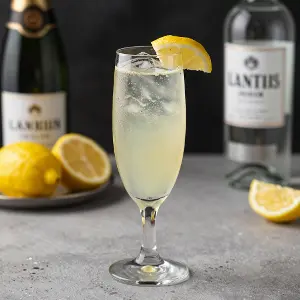
The French 75 is a sparkling, deceptively powerful cocktail built from gin, fresh lemon juice, simple syrup, and Champagne — light and bubbly on the surface, but strong enough to earn its name from a punishing piece of World War I artillery. It's one of the great celebratory cocktails, sitting alongside other Champagne classics on the site like the Champagne Cocktail and Kir Royale, though its gin-and-lemon base gives it a sharper, more spirit-forward edge than either.
The drink's name comes from the French 75mm field gun, a rapid-firing artillery piece renowned for its punch during World War I — a fitting namesake for a cocktail whose champagne fizz disguises real strength underneath. The cocktail is popularly credited to Harry MacElhone, the Scottish-born bartender who took over Harry's New York Bar in Paris in 1923 and is linked to a long list of classic cocktails, including the Sidecar and the Boulevardier. Cocktail historians have since complicated that tidy origin story, though: some early references to a "Henry" behind the drink actually point to Henry Tépé of a different Paris bar, Henry's Bar, rather than to Harry MacElhone at all, and MacElhone himself never claimed credit for a Soixante-Quinze or French 75 in his own writings, a nuance detailed in Difford's Guide's history of the French 75. What's clearer is the drink's early evolution — the original 1920s version was built with Cognac rather than gin, and only later shifted toward the gin-based recipe most bars serve today. Whichever bartender actually gets the credit, the French 75 became a fixture of 1920s Paris drinking culture and has remained one of the most consistently popular pre-Prohibition-era cocktails ever since.
Gin provides a dry, botanical backbone, its juniper and citrus notes threading through the drink without ever fully taking over. Fresh lemon juice adds sharp, clean acidity, while a touch of simple syrup rounds out the tartness just enough to keep the drink balanced rather than puckering. Champagne tops the whole mixture with fine bubbles and its own layer of yeasty, toasty complexity, lifting the drink and adding a celebratory effervescence that a still cocktail simply can't match. The overall effect is crisp, dry, and elegant, with more genuine spirit strength hiding behind the bubbles than the drink's light appearance suggests — hence the artillery reference in its name.
Shake 1 oz gin, 0.5 oz fresh lemon juice, and 0.5 oz simple syrup with ice until well chilled, then strain into a Champagne flute. Top slowly with 3 oz chilled Champagne, tilting the glass to preserve as much carbonation as possible. Garnish with a long lemon twist expressed over the glass. For the historically accurate original, Cognac can be swapped in for gin in equal measure, producing a warmer, richer version sometimes labeled a "French 125" on cocktail menus that want to distinguish it from the now-standard gin recipe, a variation documented in Difford's Guide's French 125 recipe.
Because the French 75's formula is so simple — spirit, citrus, sweetener, sparkling wine — it's easy to riff on. Swapping gin for Cognac produces a smoother, more autumn-appropriate drink well suited to holiday gatherings, while a floral variation adds a splash of elderflower liqueur before the Champagne for a more aromatic, spring-leaning pour. The Singapore Sling, another gin-and-fruit classic from roughly the same era, shows a similar willingness to combine gin with fruit and citrus into something more elaborate, though it leans tropical rather than celebratory the way the French 75 does. Drinkers curious about gin's range more broadly can find eight more foundational gin cocktails, including the French 75 itself, in the site's guide to the best gin cocktails to make at home.
A tall Champagne flute is the traditional serve, both for presentation and because its narrow shape helps preserve carbonation longer than a wider glass would. A lemon twist is the classic garnish. The French 75 is built for toasts and celebrations — New Year's Eve, weddings, and any occasion that calls for something more elegant than a standard cocktail but with more punch than a plain glass of Champagne, making it a natural companion to other Prohibition-era classics like the site's Sidecar and Boulevardier.
More than a century after its contested Parisian origins, the French 75 endures because it delivers exactly what its reputation promises: an elegant, celebratory drink with genuine strength underneath the bubbles. Its simplicity — just four ingredients, easily shaken and topped with Champagne — has kept it accessible to home bartenders even as more elaborate craft cocktails have come and gone. Combined with its evocative wartime name and Prohibition-era pedigree, the French 75 has held onto a spot as one of the most requested celebratory cocktails on modern bar menus, right alongside its sister Champagne drinks like the Mimosa and Bellini.