Mix. Drink. Enjoy.
Discover amazing cocktail recipes and elevate your mixology game
Mix. Drink. Enjoy.
Discover amazing cocktail recipes and elevate your mixology game
Posted: July 14, 2026
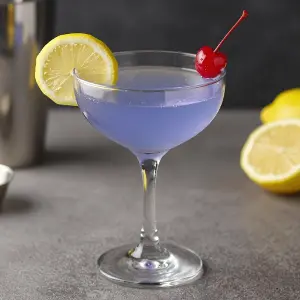
The Aviation is a pale, blue-violet gin cocktail that combines gin, maraschino liqueur, fresh lemon juice, and crème de violette into a floral, tart, subtly nutty drink named for its striking resemblance to the sky at high altitude. It's a Prohibition-era classic that shares its DNA with other gin sours on the site like the Last Word and the simpler Gimlet, though its unique violet liqueur and near-disappearance from bars make it one of the more dramatic comeback stories in modern cocktail history.
The Aviation first appeared in print in 1916, in bartender Hugo Ensslin's Recipes for Mixed Drinks, published while Ensslin was head bartender at New York's Hotel Wallick — a book widely considered the last major American cocktail manual before Prohibition shuttered the country's bars a few years later. Ensslin's original recipe called for gin, maraschino liqueur, crème de violette, and lemon juice, with the violet liqueur giving the drink both its name and its signature pale lavender-blue color, reminiscent of the sky viewed from an early aircraft. The drink went on to appear in Harry Craddock's influential 1930 Savoy Cocktail Book, though notably without crème de violette — Craddock's version, sometimes now called the "Savoy Aviation," left the ingredient out entirely, likely because it was already becoming hard to source. That absence turned into total obscurity for most of the 20th century: after crème de violette's sole American producer stopped making it, the ingredient effectively vanished from the U.S. market, and bartenders who kept serving an "Aviation" for decades were unknowingly making a plain gin-and-maraschino sour, missing the very ingredient the drink was named after. The turning point came in 2007, when Rothman & Winter relaunched their crème de violette — made with violets grown in the Austrian Alps — for the American market. Cocktail enthusiasts and craft bartenders treated its return less as a novelty and more as a restoration, reviving the Aviation's true original recipe and cementing its place as an essential of the craft cocktail revival, a comeback story recounted in detail by Wikipedia's history of the Aviation.
Gin provides a juniper-forward, botanical backbone, while maraschino liqueur adds a distinctive sweet, slightly nutty cherry-pit flavor that's unlike any other common cocktail sweetener. Fresh lemon juice supplies bright acidity to balance both, and crème de violette layers a delicate, unmistakably floral note over the top — present but not overwhelming when used in the right proportion. The overall effect is elegant and complex: tart and citrus-forward up front, with maraschino's nutty sweetness and violette's perfume unfolding as the drink is sipped. Too much crème de violette can push the drink toward tasting like perfume, which is why most modern recipes use it sparingly, often just a few drops rather than a full measure.
Shake 2 oz gin, 0.5 oz maraschino liqueur, 0.75 oz fresh lemon juice, and 0.25 oz crème de violette with ice until well chilled. Strain into a chilled coupe glass. No garnish is strictly traditional, though a brandied or maraschino cherry is sometimes added. Because crème de violette is intensely aromatic, precision matters here more than in most cocktails — even a small overpour can throw off the balance and push the drink toward soap-like floral flavors rather than a subtle, supporting note, a caution echoed in Difford's Guide's Aviation cocktail recipe.
The most historically significant variation is the "Savoy Aviation," which simply omits crème de violette entirely, resulting in a clear cocktail with more prominent citrus and maraschino flavor — effectively the version most drinkers were served for the better part of a century. The Blue Moon, a related but distinct cocktail, flips the Aviation's proportions by using crème de violette as the dominant sweetener rather than maraschino liqueur. Some modern bartenders substitute elderflower liqueur for maraschino for a lighter, more floral riff, while others swap in a cherry brandy when maraschino liqueur isn't available. That same minimalist, citrus-driven approach carries over to the site's Vodka Gimlet, another easy three-ingredient cocktail built for small, deliberate substitutions. Drinkers who enjoy the Aviation's gin-and-liqueur sophistication might also appreciate the site's Last Word, another Prohibition-era gin classic built on an equal-parts formula of gin, green Chartreuse, maraschino liqueur, and lime.
A chilled coupe glass is the standard serve, showing off the drink's pale, distinctive color. It's a sophisticated, sipping cocktail best suited to a dressed-up evening or a craft cocktail bar rather than a casual gathering, occupying similar territory to other Prohibition-era gin classics like the site's Gin Fizz and the Campari-forward Negroni. Its striking appearance also makes it a popular choice for cocktail enthusiasts looking to show off a well-stocked home bar cabinet, since crème de violette remains a specialty ingredient many casual drinkers have never encountered.
Few cocktails have a comeback story as clean as the Aviation's: an ingredient disappears, the drink survives in a diminished, incomplete form for decades, and then a single product relaunch in 2007 restores it to its original glory almost overnight. That story has made the Aviation a favorite talking point among craft bartenders, and its genuinely elegant, well-balanced flavor has kept it on menus well beyond its novelty value. For drinkers exploring gin's full range beyond straightforward drinks like the site's Gin Basil Smash, the Aviation remains one of the best entry points into the more elaborate, historically layered side of gin cocktails — a category covered more broadly in the site's guide to the best gin cocktails to make at home.