Mix. Drink. Enjoy.
Discover amazing cocktail recipes and elevate your mixology game
Mix. Drink. Enjoy.
Discover amazing cocktail recipes and elevate your mixology game
Posted: August 5, 2026
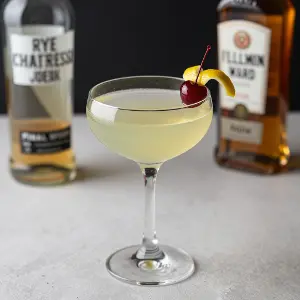
The Final Ward is one of the most celebrated modern classic cocktails in the bartender's canon — an equal-parts drink built from rye whiskey, green Chartreuse, maraschino liqueur, and fresh lemon juice. Shaken hard and strained into a chilled coupe, it delivers a remarkable balance of herbaceous complexity, sweet cherry richness, bright citrus, and whiskey backbone. Every sip feels simultaneously bold and harmonious, which is exactly why it has become a benchmark cocktail since its creation in 2007.
Unlike the spirit-forward simplicity of an Old Fashioned or the long, refreshing character of a Whisky Sour, the Final Ward belongs to a special category of cocktails where no single ingredient dominates — every element pulls equal weight, and the result is greater than the sum of its parts.
The Final Ward was created by Sam Ross at Milk & Honey, the legendary Lower East Side bar that fundamentally changed the course of modern cocktail culture. Ross, who would later become one of the most influential bartenders in New York alongside his partner Michael McIlroy at Attaboy, developed the drink as a direct riff on The Last Word — a Prohibition-era equal-parts cocktail made with gin, green Chartreuse, maraschino liqueur, and lime juice.
Ross's innovation was deceptively simple: swap the gin for rye whiskey and the lime for lemon. The result transformed the floral, botanical quality of the original into something grainier, spicier, and more assertively American. The rye's characteristic peppery bite cuts through the sweetness of the Chartreuse and maraschino in a way that gin cannot, while lemon's slightly softer acidity compared to lime allows the herbal notes to come forward more prominently.
The cocktail also carries a structural connection to Paper Plane, another famous equal-parts drink — also attributed to Sam Ross — demonstrating Ross's affinity for this elegant, symmetrical approach to cocktail building. You can read more about the drink's heritage on Difford's Guide.
The Final Ward is a complex, medium-bodied cocktail that rewards slow sipping. On the nose, you'll catch the herbal intensity of green Chartreuse — a liqueur made from 130 botanicals by Carthusian monks in France — mingling with the sweet cherry aroma of maraschino. The rye whiskey announces itself with spice and warmth, while the lemon provides a clean, bright top note that keeps everything feeling fresh rather than heavy.
On the palate, the drink opens with citrus tartness, transitions through the Chartreuse's wild botanical character, finds sweetness in the maraschino, and closes on the long, warm finish of rye. The equal-parts structure means no single flavor lingers too long before the next takes over, creating a cocktail that is genuinely difficult to stop drinking. It occupies the same flavor territory as the Clover Club and Penicillin in its ability to satisfy drinkers who want complexity without fussiness.
The Final Ward calls for equal parts of all four ingredients: three-quarters of an ounce each of rye whiskey, green Chartreuse, maraschino liqueur, and fresh lemon juice. Combine everything in a shaker with plenty of ice and shake vigorously for at least fifteen seconds — the dilution and chill are critical to the drink's balance. Double-strain through a Hawthorne strainer and fine mesh sieve into a chilled coupe glass. No garnish is traditional, though a lemon twist or brandied cherry is occasionally used.
The choice of rye whiskey matters more here than in many cocktails because the spirit must hold its own against two very assertive liqueurs. A higher-proof bonded rye (100 proof) works particularly well, as the extra alcohol helps the whiskey project through the Chartreuse and maraschino rather than disappearing into them.
Substituting bourbon whiskey for rye creates a sweeter, rounder version of the drink. The vanilla and caramel notes of bourbon soften the Chartreuse's edge and make the cocktail more approachable for drinkers who find rye's spice too assertive. The drink loses a little of its characteristic tension but gains warmth and accessibility.
Swapping green Chartreuse for its yellow counterpart — milder, lower proof, and more honeyed — produces a gentler, less herbaceous drink that leans sweeter and more floral. This version is a useful bridge for guests who find the green Chartreuse version too intense on first encounter.
The Final Ward and The Last Word are best understood as a pair — the gin original and the whiskey evolution. Serving them side by side is a compelling tasting exercise that illustrates how a single substitution can completely reframe a drink's personality while leaving its DNA intact. Many bars that feature one will feature the other, and exploring both is an excellent introduction to how modern bartenders think about creative riffing.
If the Final Ward's equal-parts philosophy appeals to you, the Paper Plane — equal parts bourbon, Aperol, Campari, and lemon juice — follows the same structural logic with a completely different flavor destination. For whiskey drinkers who prefer stirred cocktails, the Boulevardier covers similar bittersweet territory through a different lens. Our guide to the best bourbon cocktails offers a broader look at how American whiskey performs across a wide variety of styles, from classics to modern inventions.
The Final Ward also pairs beautifully at the table. Its herbaceous bitterness and citrus brightness make it an excellent aperitif before a rich meal, and it holds up well alongside charcuterie boards, aged cheeses, and bitter greens. The maraschino's cherry sweetness makes it a natural companion to duck, lamb, and other red meats with fruit-forward preparations. For dessert, it complements chocolate-based dishes without being overwhelmed by their sweetness — the Whisky Advocate calls it one of the great food-pairing cocktails of the modern era.
In an era of cocktails that sometimes prioritize novelty over balance, the Final Ward has endured because it is structurally perfect. The equal-parts format is both a constraint and a creative achievement — within it, every ingredient must earn its place, and in the Final Ward, every ingredient does exactly that. Rye, Chartreuse, maraschino, and lemon have rarely been better friends.
It is also a cocktail that rewards the curious drinker. Each ingredient carries its own rich story — rye whiskey's American grain heritage, Chartreuse's centuries of monastic tradition, maraschino's Dalmatian origins — and together they form something genuinely greater than their sum. Whether you are a seasoned cocktail enthusiast or just beginning to explore the world of craft drinks beyond the Whisky Sour, the Final Ward is a cocktail that will stay with you long after the coupe is empty.