Mix. Drink. Enjoy.
Discover amazing cocktail recipes and elevate your mixology game
Mix. Drink. Enjoy.
Discover amazing cocktail recipes and elevate your mixology game
Posted: April 14, 2025
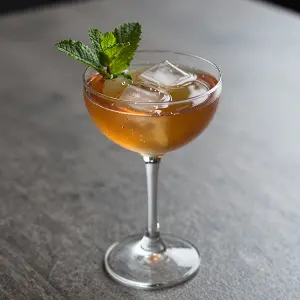
The Stinger is a two-ingredient classic that pairs Cognac's rich, oaky warmth with the cool, sharp bite of white crème de menthe. It's a stirred, spirit-forward drink rather than a fruity or citrus-driven one, built to be sipped slowly after a meal rather than downed quickly. That combination of grape brandy and mint liqueur puts it in the same after-dinner category as the Brandy Alexander, another Cognac-based dessert cocktail, though the Stinger is drier, colder, and far less creamy — closer to a digestif than a dessert in a glass.
The Stinger's roots go back to 1890s New York, where it evolved out of an earlier drink called the Bartholdi Cocktail, served at the Bartholdi Hotel and made from Cognac, crème de menthe, and gum syrup. According to Wikipedia's history of the Stinger, the drink may also trace back to "The Judge," a similar brandy-and-crème-de-menthe cocktail documented in William Schmidt's 1892 book The Flowing Bowl. Bartenders gradually simplified the recipe, dropping the sugar syrup at bars like the Holland House until only Cognac and crème de menthe remained. The name "Stinger" first appeared in bartending manuals around 1914, and the drink became a fixture of high-society New York drinking through the 1920s, with Reginald Vanderbilt reportedly among the Manhattan socialites who helped popularize it as a refined nightcap. It stayed a staple of American bars for decades, peaking in popularity through the mid-20th century before falling out of fashion — along with most mint-and-brandy drinks — by the 1970s.
The Stinger's flavor is built entirely around the tension between two strong, distinct ingredients. Cognac contributes deep notes of dried fruit, vanilla, and oak from its barrel aging, giving the drink real weight and warmth. White crème de menthe cuts directly across that richness with a cold, sweet, intensely minty flavor that hits almost like a palate cleanser. Together they create a cocktail that's sweet, strong, and bracingly cool all at once — sophisticated rather than fun, and much more spirit-forward than most mint-flavored drinks. Because there are only two ingredients, the balance between them is everything: a well-made Stinger tastes like Cognac with a cooling mint finish, not like a minty drink with a splash of brandy.
The classic ratio is 2 oz Cognac to 1 oz white crème de menthe, stirred with ice in a mixing glass and strained into a chilled coupe or cocktail glass. Some versions serve it on the rocks in an old-fashioned glass instead, which softens the intensity slightly as the ice melts. White crème de menthe is preferred over the green variety for its clean, clear appearance in the glass, though the flavor is identical between the two colors — a point PUNCH's Stinger recipe also emphasizes for anyone building the drink at home. No garnish is traditionally required, though a fresh mint sprig is sometimes added for aroma. Because both ingredients are strong and sweet, precision matters more here than in drinks with more forgiving ratios — too much crème de menthe quickly turns the drink cloying, while too little leaves the Cognac unbalanced and overly hot.
The Stinger's simple two-ingredient formula has spawned a long list of riffs over the decades. The White Stinger swaps Cognac for vodka and adds white crème de cacao alongside the crème de menthe, producing a chocolate-mint flavor often compared to an "After Eight" mint in liquid form. The Mexican Stinger substitutes tequila for Cognac, while the Dixie Stinger trades Cognac for bourbon and adds peach liqueur, moving the drink closer to a Southern classic like the Mint Julep in spirit, if not in method. The Emerald variation simply uses green crème de menthe instead of white for a more traditional mint-green color, while the Tea Sting infuses the Cognac with green tea before mixing, producing a floral, almost herbal riff reminiscent of Moroccan mint tea.
The Stinger is traditionally served in a chilled coupe or cocktail glass for a straight-up presentation, or over ice in a rocks glass for a slower, more diluted sip. It's a nightcap drink through and through — meant for the end of a meal or the end of an evening, alongside other spirit-forward classics like the Sazerac or a well-made Negroni. It doesn't call for elaborate garnish or presentation, since its appeal has always been in the boldness and simplicity of the two ingredients rather than any visual flourish.
Cocktail trends have cycled through Prohibition-era classics like the Sidecar and the Last Word more than once over the past century, and the Stinger has ridden a similar wave of rediscovery among bartenders drawn to pre-Prohibition and early-20th-century drinks. Its appeal today is much the same as it was in Reginald Vanderbilt's era: it's bold, unapologetically strong, and completely unlike the fruit-forward, low-proof cocktails that dominate most modern drink menus. For anyone exploring the world of Cognac cocktails beyond the more familiar dessert-style drinks, the Stinger remains one of the clearest, most direct ways to experience what a good Cognac can do when it's given very little to hide behind. It also works well as a small, focused nightcap after dinner, standing in for coffee or a standalone dessert when paired with dark chocolate or a simple plate of biscotti — rich enough to feel indulgent, but cold and minty enough to still read as refreshing rather than heavy.