Mix. Drink. Enjoy.
Discover amazing cocktail recipes and elevate your mixology game
Mix. Drink. Enjoy.
Discover amazing cocktail recipes and elevate your mixology game
Posted: November 22, 2023
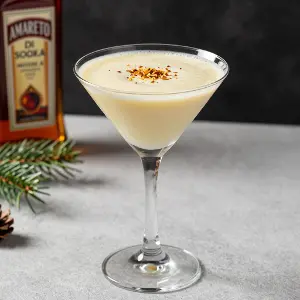
The Eggnog Martini takes traditional Christmas eggnog and pours it into a coupe instead of a punch cup, shaking it with vanilla vodka and amaretto to turn a beloved holiday sipper into a proper cocktail-hour drink. It keeps everything that makes classic eggnog appealing, the rich, custardy sweetness, the warm spice of nutmeg, but sharpens the presentation and boosts the proof, landing somewhere between a dessert and a nightcap. It's a drink built entirely for the season it belongs to, showing up on menus the moment eggnog itself hits grocery store shelves and disappearing again once the holidays wrap.
Eggnog's roots reach back much further than its modern martini variation. According to a history of the drink from The View from Great Island, eggnog descends from posset, a medieval British drink of hot milk mixed with wine or ale, which monks eventually enriched with eggs, gradually swapping ale for sherry. The name itself likely comes from "nog," an old English word for either strong ale or a small wooden cup the drink was traditionally served in. When eggnog crossed the Atlantic with colonists, it became a luxury treat for early Americans, and because sherry was hard to come by in the colonies, settlers substituted more widely available whiskey and rum instead, a swap that gave American eggnog its distinctly boozier character. The term "eggnog" itself first appeared in American writing in the 1770s.
Eggnog's early American history comes with real historical color. George Washington is widely believed to have served the drink to guests at Mount Vernon during the holidays, and although historians can't definitively confirm the exact recipe was his own, the version commonly attributed to him combines brandy, rye whiskey, Jamaican rum, and sherry, a formidable, multi-spirit build that says a lot about colonial drinking habits. The drink's cultural weight is underscored by the 1826 Eggnog Riot at West Point, where cadets smuggled whiskey onto the officially dry campus specifically to spike their holiday eggnog, a scheme that escalated into a genuine disturbance. The Eggnog Martini itself is a far more recent invention, emerging as craft cocktail bars in the 1990s and 2000s began reworking holiday classics into shaken, bar-format drinks.
Expect rich, custardy sweetness up front, with warm spice and a noticeable kick underneath. Store-bought or homemade eggnog supplies the base flavor, creamy, eggy, and lightly spiced with nutmeg and sometimes cinnamon, while vanilla vodka reinforces the drink's sweet, dessert-like character rather than cutting against it. Amaretto adds a layer of toasted almond sweetness that complements eggnog's own nutmeg spice, echoing the way Sugar Cookie Martini also leans on amaretto to build out its holiday-dessert flavor. A recipe from Nutmeg Nanny keeps the build this simple, eggnog, vanilla vodka, and amaretto shaken hard and finished with fresh nutmeg, proof the format needs very little embellishment to feel festive. That final grating of nutmeg ties the whole shaken cocktail back to its punch-bowl origins.
Bourbon or spiced rum stand in for vodka in some versions, echoing the whiskey-and-rum substitutions early American colonists made when sherry wasn't available, and producing a warmer, more spirit-forward drink than the vanilla vodka original. Chocolate lovers often push the format toward dessert territory entirely, layering in crème de cacao for something closer to a Chocolate Martini dressed up with eggnog's custard richness. Peppermint versions swap amaretto for peppermint schnapps, landing in the same minty, dessert-cocktail territory as a White Chocolate Peppermint Martini, while a candy-striped garnish and crushed peppermint rim can push it even closer to a Candy Cane Martini in presentation. All of these variations share the same basic logic as the original: take a familiar holiday flavor and rebuild it as a shaken, martini-glass cocktail.
Fill a shaker with ice, then add eggnog, vanilla vodka, and amaretto, and shake well, longer than you might expect, since eggnog's thickness needs a proper shake to fully combine and chill. Strain into a chilled martini glass or coupe rather than pouring over ice, keeping the presentation elegant and cocktail-forward rather than punch-bowl casual. Finish with a generous grating of fresh nutmeg across the surface, and for extra holiday flair, a cinnamon-sugar rim or a small cinnamon stick garnish adds both aroma and a festive visual touch. Because the drink is rich and creamy, smaller pours in a proper martini glass work better than oversized servings.
This is a dessert cocktail through and through, built for Christmas parties, New Year's Eve toasts, or a cozy night in by the fireplace. It pairs naturally with gingerbread, shortbread, spiced holiday cookies, or a slice of pumpkin or pecan pie, and it fits comfortably on a holiday cocktail menu alongside a Christmas Punch for guests who'd rather sip something bowl-served and communal, or a playful, bright-green Grinch Cocktail for guests who want something lighter and less rich. Because of its richness, it works best as an after-dinner pour rather than an opening cocktail, similar to how a warm Hot Toddy tends to close out a winter evening rather than start one.
The Eggnog Martini endures because it solves a real seasonal problem: eggnog on its own can feel heavy and old-fashioned, poured from a carton into a mug, while the martini format gives it a bar-worthy presentation without asking it to abandon what makes it comforting in the first place. It's an easy sell at holiday parties, since almost everyone already has an opinion about eggnog, and shaking it into a proper cocktail turns that nostalgia into something that feels a little more grown-up. As long as grocery stores keep stocking eggnog every November, the Eggnog Martini is likely to keep showing up on holiday cocktail menus right alongside it.