Mix. Drink. Enjoy.
Discover amazing cocktail recipes and elevate your mixology game
Mix. Drink. Enjoy.
Discover amazing cocktail recipes and elevate your mixology game
Posted: August 1, 2026
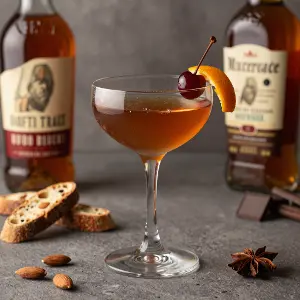
The Biscotti Manhattan is a supremely elegant riff on one of history's great cocktails — a Manhattan that has traveled from the clubs of nineteenth-century New York to the sun-baked almond groves of northern Italy and returned carrying a remarkable souvenir: Biscotti Liqueur, the extraordinary Italian liqueur that captures the flavors of traditional cantucci biscuits — almonds, fennel, citrus, and caramel — in liquid form. Built on bourbon whiskey, sweet vermouth, and a dash of mole bitters, the Biscotti Manhattan is what happens when American whiskey tradition meets Italian pastry culture — and the result is astonishing.
The Manhattan is one of the oldest and most celebrated cocktails in the American canon. Its precise origin is disputed, but the most widely accepted story places its creation at the Manhattan Club in New York City in the 1870s, where it was supposedly invented at a banquet hosted by Jennie Jerome (mother of Winston Churchill). What is certain is that by the 1880s the Manhattan was already well established in bartending guides, and by the turn of the twentieth century it had become the premier stirred whiskey cocktail in America — a position it has never relinquished. The classic formula is deceptively simple: whiskey (traditionally rye, though bourbon became increasingly popular through the twentieth century), sweet vermouth, and a dash or two of aromatic bitters, stirred with ice and served in a coupe or cocktail glass with a maraschino cherry. The classic Manhattan represents everything great about stirred cocktails: balance, elegance, and an economy of means that forces each ingredient to earn its place in the glass.
The Biscotti Manhattan is the latest in a long tradition of Manhattan riffs — cocktails that accept the bourbon-vermouth-bitters template and modify it with a fourth ingredient that introduces a new flavor dimension. The Liberal Cocktail adds Campari for bitterness; the Preakness Cocktail incorporates Bénédictine for herbal sweetness; and the Biscotti Manhattan adds biscotti liqueur for Italian almond-pastry depth. Each variation tells a different story while remaining recognizably within the Manhattan family.
To understand the Biscotti Manhattan, you must understand its most distinctive ingredient. Faretti Biscotti Famosi Liqueur — the primary commercial biscotti liqueur — is produced in the Trentino province of northern Italy by a joint venture between the Giori Distillati Trentini distillery and Chatham Imports. It was created to capture the flavor of cantucci — the twice-baked almond biscuits of Tuscany that are traditionally dunked in Vin Santo wine — in a spirit format. The liqueur is built on a vodka base and sweetened with beet sugar, with a complex botanical infusion that includes almonds (which give it its characteristic marzipan character), fennel (which adds a subtle anise note), citrus peel (which provides brightness and lift), and caramelized sugar (which rounds everything into a warm, pastry-like whole). The result is one of the most distinctively flavored liqueurs in the world — one that tastes of an Italian pastry case: buttery, almond-forward, gently fennel-scented, and warmly sweet. Faretti Biscotti won a Double Gold Medal at the San Francisco World Spirits Competition and received a 97-point score from the Wine Enthusiast, which described it as having "a rich roasted-almond aroma" and "sweet, syrupy, almond-paste flavor flecked with fennel." See the full Biscotti Liqueur cocktail collection for other creative applications of this extraordinary ingredient.
The genius of the Biscotti Manhattan lies in the unexpected affinity between bourbon whiskey and biscotti liqueur. At first glance, Kentucky bourbon and Italian almond biscuits seem like unlikely companions — one is a product of the American South, steeped in oak and vanilla and caramel from years in new charred barrels; the other is a product of northern Italian bakeries and distilleries, fragrant with almonds and fennel and citrus. But tasted together, their compatibility is immediately apparent: bourbon's inherent vanilla, caramel, and baking-spice notes mirror the biscotti liqueur's almond-caramel-pastry character. Both bourbon and biscotti liqueur evoke the warmth of a bakery — one an American one, the other Italian — and the combination produces something that is greater than either ingredient alone: a cocktail that feels simultaneously familiar and exotic, deeply warming and subtly complex. The mole bitters — with their cacao, cinnamon, and chili complexity — provide the final aromatic framework that ties bourbon's wood-spice to biscotti liqueur's almond character. This depth makes the Biscotti Manhattan as interesting a sipper as the famous Benton's Old Fashioned, which similarly uses fat-washing and bold flavors to reframe bourbon in an unexpected culinary context.
The Biscotti Manhattan is a sipping cocktail in the truest sense — a drink that rewards slow, attentive drinking as its layers reveal themselves one by one. On the nose, bourbon leads: the sweet vanilla-caramel aromatics of a well-aged Kentucky whiskey, supported by the deeper, more earthy notes of the sweet vermouth's herbal complexity. Then something else appears — a warm, roasted-almond quality that floats just above the bourbon, identifiably Italian in character, speaking of biscotti and amaretti and the almond-scented pastry cases of Tuscany. On the palate, the vermouth's dried-fruit richness (Carpano Antica Formula, the gold standard for Manhattan vermouth, carries notes of vanilla, fig, and dried orange peel) merges seamlessly with the bourbon's caramel warmth, while the biscotti liqueur adds a middle note of almond paste and fennel that is subtle but unmistakable. The mole bitters finish with a dark chocolate and gentle chili warmth that lingers on the palate and connects the cocktail's Italian and American elements. The overall impression is of a Manhattan that has been enriched and deepened rather than transformed — recognizably itself, but more interesting, more complex, and more surprising than the original. The Fancy Free Cocktail and the Boulevardier are close relatives in the stirred-spirit-and-vermouth family that the Biscotti Manhattan belongs to.
The Biscotti Manhattan is a cocktail where ingredient quality matters significantly. On the bourbon side, choose a bottle with pronounced vanilla and caramel character rather than a heavily spiced or high-rye expression — the sweeter, richer style of bourbons like Maker's Mark, Buffalo Trace, or Four Roses Single Barrel complement the biscotti liqueur's almond-pastry character better than more austere rye-forward expressions. For the vermouth, Carpano Antica Formula is the traditional choice on the Difford's Guide recipe and for good reason: its Italian origin, its vanilla-forward sweetness, and its dried-fruit complexity are perfect companions for both the bourbon and the biscotti liqueur. Cocchi Storico Vermouth di Torino is an excellent alternative. For the bitters, true mole bitters (Bittermens Xocolatl Mole or Fee Brothers Aztec Chocolate are the most available) provide the specific cacao-cinnamon-chili profile the recipe calls for, though a good chocolate bitters works as a substitute. The biscotti liqueur is Faretti Biscotti Famosi — the only widely available commercial expression of this specific flavor profile. For the stirring, see MixDrinkEnjoy's cocktail techniques guide for detailed guidance on achieving perfect dilution and temperature in stirred drinks.
The Biscotti Manhattan is a stirred, spirit-forward drink — it should never be shaken. Shaking introduces too much dilution and aeration for a drink whose appeal lies in its density, weight, and layered complexity. Add all four ingredients to a mixing glass filled with ice and stir for a full 25–30 seconds, until the outside of the mixing glass is frosted and the cocktail is well-chilled and properly diluted. Strain into a chilled coupe glass. The traditional garnish is a maraschino cherry or an orange twist — the latter works particularly well here, as the citrus oils in the twist echo the citrus peel in the biscotti liqueur and add an aromatic lift that brightens the cocktail's opening impression. According to Difford's Guide's Biscotti Manhattan page, the classic ratio is 45ml bourbon, 30ml Carpano Antica Formula, 15ml Faretti Biscotti, and 1 dash mole bitters. For additional context on Manhattan-family cocktails and technique, Liquor.com's Manhattan guide is an excellent resource.
The Biscotti Manhattan is a cocktail of the evening — rich, complex, and warming, it suits the hours after dinner as much as the hour before. As an aperitif, its bitter-sweet structure and aromatic complexity stimulate the appetite without filling it; as a digestif, its warmth and almond depth provide a satisfying close to a meal. Food pairings should lean Italian: dark chocolate, traditional cantucci biscuits (for the meta pleasure of pairing the cocktail with its namesake), almond-paste pastries, aged Parmigiano-Reggiano, or a simple board of Italian charcuterie. The cocktail's bourbon backbone also makes it comfortable alongside American-style desserts: bourbon pecan pie, salted caramel tart, or brown butter blondies. The Haystack Cocktail and the Old Fashioned round out a sophisticated bourbon cocktail menu alongside the Biscotti Manhattan.